Multi-Agent AI in the Real World: Architectures, Use Cases, and Deployment Tradeoffs
What Multi-Agent Systems Actually Solve in AI Products
Most AI products do not need a swarm of agents. In practice, a single LLM with good tools, retrieval, and a clear prompt chain is often the right starting point. Multi-agent design becomes useful when the product has to handle distinct subproblems with different goals, permissions, or validation needs.
A good rule of thumb: if your workflow naturally breaks into specialized roles that would already exist in a human process, multiple agents may help. If not, you may just be adding latency, cost, and failure modes.
Multi-agent systems tend to be valuable in cases like:
-
Customer support
- One agent classifies intent and urgency
- Another retrieves account or policy context
- A response agent drafts the reply
- A verifier checks compliance, refunds, or escalation rules
-
Enterprise search
- A planner rewrites ambiguous queries
- A retrieval agent searches across systems
- A synthesis agent merges evidence
- A citation or guardrail agent checks source grounding
-
Coding assistants
- One agent explores the codebase
- Another proposes edits
- A test agent runs validation
- A review agent checks style, security, or regression risk
-
Operations automation
- An incident agent summarizes alerts
- A diagnostics agent queries logs/metrics
- A remediation agent proposes or executes runbooks
- A safety agent enforces approval thresholds
Where teams go wrong is using many agents when they really need better orchestration. If the problem is “answer a question using company docs,” a single LLM plus retrieval is usually enough. If the problem is “answer correctly, cite sources, follow policy, and escalate safely when confidence is low,” specialization starts to pay off.
A practical architecture test is: can each agent own a measurable responsibility? For example:
agents = [
  "triage",
  "retrieval",
  "drafting",
  "verification"
]
If you cannot define clear inputs, outputs, and success metrics for each role, keep the system simpler. In production, multi-agent systems solve coordination and trust problems more than raw intelligence problems.
Reference Architectures for RAG and Agentic Workflows
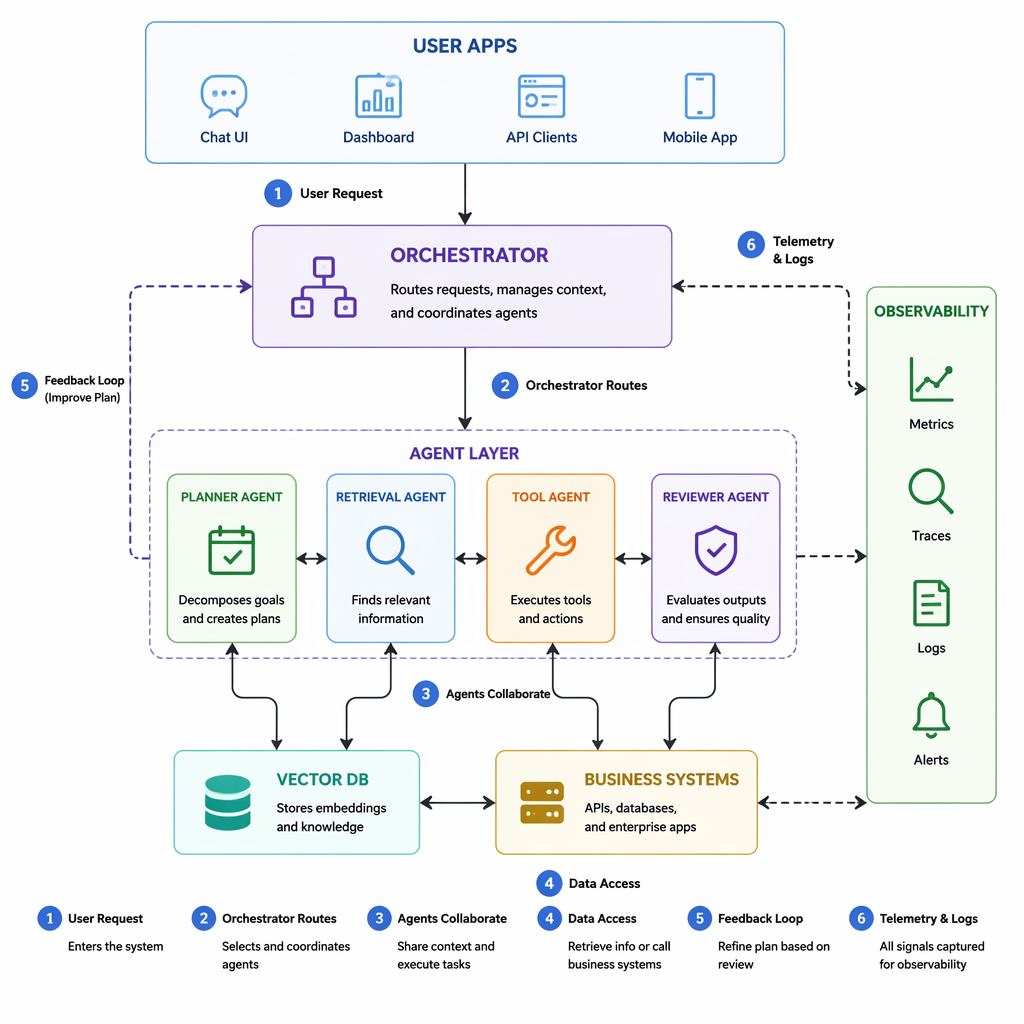
In production, multi-agent architecture is less about “how many agents” and more about clear boundaries: who plans, who executes, what context each component can see, and how failures are contained. For RAG and agentic systems, a few reference patterns show up repeatedly.
A common starting point is a central orchestrator pattern. One planner or controller receives the user request, decides which specialist agents to invoke, aggregates outputs, and returns a final answer. This works well when teams need:
- predictable routing
- centralized audit logs
- cost controls
- easier policy enforcement
In a customer support RAG workflow, for example, the orchestrator may call:
- a retrieval agent for document search,
- a policy agent for compliance checks,
- an action agent for CRM updates.
result = orchestrator.run(
    query=user_query,
    agents=[retriever, policy_checker, crm_executor]
)
The tradeoff is that the orchestrator can become a bottleneck and a single point of failure. Peer-to-peer agents reduce that coordination burden by allowing agents to hand off tasks directly, but they are harder to debug and govern. In regulated environments, most teams prefer centralized orchestration first, then introduce selective delegation later.
Memory design is another major architectural decision. Shared context makes collaboration easier, but it also increases token cost, leakage risk, and prompt contamination. In practice, teams often use:
- shared task state for workflow metadata
- scoped working memory per agent
- separate long-term memory stores for durable facts or prior outcomes
This keeps the retrieval agent from seeing unnecessary action history, while still letting the orchestrator maintain end-to-end traceability.
Tool access should also be explicitly partitioned. Not every agent should be able to call every API. A good default is:
- retrieval agents: vector DB, keyword search, document stores
- reasoning agents: no side-effecting tools
- action agents: transactional systems behind approval gates
For execution, sync flows are simpler for chat experiences, while async flows are better for long-running research, batch enrichment, or workflows involving retries and human approval. Failure handling usually includes timeouts, fallback prompts, retry budgets, circuit breakers, and partial-result completion. In real systems, graceful degradation beats perfect intelligence: if one agent fails, the system should still return something useful, explain uncertainty, and log enough detail for operators to fix the issue quickly.
Real-World Use Cases: Support, Research, Coding, and Operations
Multi-agent systems become compelling when a workflow is too broad for a single prompt, but still structured enough to decompose into specialized roles. In practice, the best use cases are not “fully autonomous companies.” They are bounded, high-volume workflows where teams already have SOPs, APIs, and measurable business outcomes.
Customer support deflection is one of the clearest examples. A typical setup includes:
- a router agent to classify intent and urgency
- a retrieval agent to pull docs, order history, or account data
- a policy/compliance agent to enforce refund or escalation rules
- a response agent to draft the final answer
Inputs usually include the customer message, CRM context, and knowledge base articles. Outputs are either a ready-to-send reply, a recommended action, or an escalation package for a human. The constraints are strict: low latency (often under a few seconds) and tight cost control at high ticket volume. This is where lightweight Python services shine: one service for orchestration, tool wrappers around Zendesk/Stripe/Salesforce, and a task queue like Celery or Dramatiq for slower background steps such as document summarization or post-resolution QA.
For analyst research copilots, the value comes from parallelism and verification. One agent searches internal and external sources, another extracts facts into structured notes, and a third critiques confidence and flags gaps. Instead of a single long answer, the output is often a briefing packet: citations, key risks, timeline, and unresolved questions. Latency can be looser—tens of seconds or even minutes—so asynchronous execution works well. A Python backend can fan out to search tools, warehouse queries, and web scrapers, then merge results into a report object stored for review.
In software delivery assistants, multiple agents can support ticket refinement, code generation, test creation, and PR review. The practical pattern is not “agent writes the whole product,” but agent chains around the existing developer workflow:
job = {
    "ticket": jira_issue,
    "repo": "billing-service",
    "checks": ["unit_tests", "lint", "security_scan"]
}
queue.enqueue("plan_task", job)
A planner agent converts the ticket into subtasks, a coding agent proposes changes, a test agent generates edge-case coverage, and a review agent compares the diff against style and security rules. Inputs include repo context, issue text, architecture docs, and CI results. Outputs are draft PRs, test files, or review comments. Cost matters less than in support, but correctness matters far more, so most teams add tool wrappers around GitHub, CI pipelines, static analyzers, and feature flag systems to keep actions observable and reversible.
Finally, internal operations automation is a strong fit because many back-office workflows are repetitive, cross-system, and rule-heavy. Think vendor onboarding, access requests, incident triage, or finance reconciliation. One agent gathers data from forms and systems of record, another validates against policy, and a third executes approved actions or generates a human approval bundle. Here, the architecture often looks like standard enterprise automation with LLMs inserted at decision points: Python microservices, message queues, audit logs, and deterministic API calls for the final step. The measurable value is straightforward: reduced handling time, fewer manual handoffs, and better auditability without requiring full autonomy.
Python Implementation Patterns That Hold Up in Production
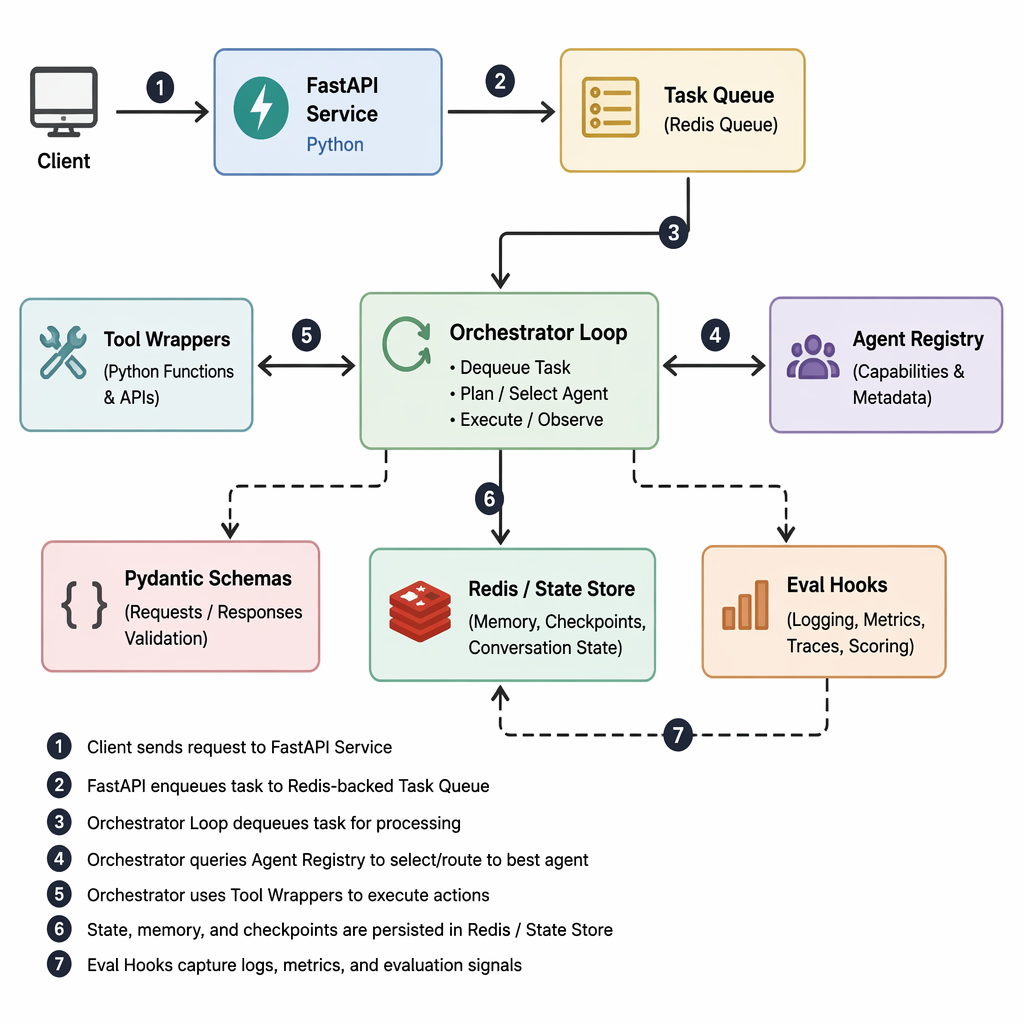
In production, multi-agent systems usually stop looking like “a clever prompt with a few function calls” and start looking like distributed application code with LLMs embedded inside. Python remains a strong fit here because it gives teams mature tooling for APIs, background jobs, validation, observability, and ML integration in one stack.
A pattern that holds up well is to define each agent as a service boundary with a strict contract, not a free-form conversational role. In practice, that means using Pydantic schemas for inputs and outputs, so downstream components can rely on typed fields instead of parsing brittle text. For example, a planner agent might return:
from pydantic import BaseModel
from typing import List

class Task(BaseModel):
    name: str
    tool: str
    priority: int

class Plan(BaseModel):
    goal: str
    tasks: List[Task]
This approach makes structured tool calling much safer. Instead of asking the model to “decide what to do next” in plain language, you constrain it to emit a valid plan, tool invocation, or review decision. That becomes especially important when agents call internal systems like billing APIs, deployment pipelines, or ticketing tools.
For orchestration, production teams often favor state machines or explicit orchestrator loops over prompt-only chains. A state machine makes retries, branching, escalation, and cancellation visible in code. Combined with a queue like Celery, Redis Queue, or cloud-native task systems, you can run long-lived workflows asynchronously, recover from worker crashes, and apply per-step timeouts. This is where code examples are particularly valuable: an orchestrator loop, retry policy, and dead-letter handling often explain more than architecture diagrams.
The same is true for retrieval pipelines and human-in-the-loop approvals. Retrieval should be a first-class step with logging and evaluation hooks, not an implicit side effect buried in prompts. And approval gates for high-risk actions—refunds, publishing, infra changes—should be explicit states in the workflow. The most reliable systems are the ones engineered like software pipelines first, and AI systems second.
Common Mistakes: Over-Agenting, Hidden Costs, and Weak Guardrails
One of the fastest ways to derail a multi-agent project is adding agents faster than adding clarity. Teams often decompose a workflow into many specialized agents because it looks elegant on a diagram: planner, researcher, analyst, writer, reviewer, critic, executor, and so on. In practice, every extra agent adds latency, prompt overhead, failure modes, and coordination complexity. If two or three agents can handle the job, ten usually make it worse. A good rule is to start with one capable agent plus tools, then split responsibilities only when you can point to a measurable benefit: lower error rate, stronger isolation, or better throughput.
Another common mistake is sharing too much context with every agent. Full conversation history, all retrieved documents, and raw tool outputs get copied everywhere “just in case.” That drives up token spend and often reduces quality because agents get buried in irrelevant information. Prefer minimal, typed handoffs:
{
  "task": "Summarize vendor risks",
  "inputs": {
    "vendor_id": "v_1842",
    "documents": ["soc2_summary", "msa_key_terms"]
  },
  "constraints": ["cite sources", "flag uncertainty"]
}
This is also where teams underestimate tool and retrieval errors. Search may return stale docs. APIs may silently fail. An execution agent may confidently act on incomplete inputs. Without guardrails, this becomes hallucinated action rather than just hallucinated text. Safer patterns include:
- Read-only by default for external systems
- Confirmation steps before side-effecting actions
- Schema validation on tool outputs
- Retries with backoff and explicit failure states
- Source citation requirements for retrieval-heavy tasks
A third major failure is skipping observability. When a workflow is slow, expensive, or wrong, teams need to know:
- Which agent made the decision
- What context it saw
- Which tools were called
- Where retries, fallbacks, or handoffs occurred
Without tracing, multi-agent systems become nearly impossible to debug. What looks like “the model is bad” is often actually poor handoff design, duplicated context, or a flaky retriever. The safer alternative is boring but effective: fewer agents, tighter contracts, stronger logging, and human approval for high-impact actions.
Deployment, Evaluation, and the Build-vs-Buy Decision
Getting a multi-agent prototype to production usually fails not because the agents are “not smart enough,” but because the surrounding system isn’t engineered for repeatability, observability, and controlled failure. The practical path is to treat agents like any other distributed system: promote through dev → staging → production, pin prompts/tool versions, and test with representative workloads before exposing users.
A common production workflow looks like this:
release_flow:
  - run offline eval suite on saved tasks
  - deploy to staging with production-like tool permissions
  - replay historical traces and compare against baseline
  - enable canary traffic in production
  - monitor cost, latency, tool error rate, and task success
  - rollback on SLA or quality regression
Offline evaluation matters because online experimentation is expensive and risky. For multi-agent systems, evaluate more than final-answer accuracy:
- Task completion rate
- Latency by agent hop
- Tool-call success/failure rate
- Cost per successful task
- Coordination errors such as duplicate work or deadlocks
- Policy/compliance violations
In production, tracing is non-negotiable. You need end-to-end visibility into which agent decided what, which tools were called, how long each step took, and where tokens/cost accumulated. Without traces, debugging agent handoffs becomes guesswork. Teams often store structured execution logs so they can replay failures, compare prompt versions, and audit sensitive actions.
Rollback strategy should be designed early. Keep versioned prompts, routing policies, and tool schemas, and support falling back to:
- a simpler single-agent path,
- a rules-based workflow,
- or human review for high-risk cases.
For SLA-aware architecture, don’t send every request through the full agent swarm. Reserve multi-agent orchestration for tasks that justify the latency and cost; use deterministic services for fast-path operations.
On build vs buy: build custom infrastructure when you need deep control over orchestration, security boundaries, bespoke evals, or tight integration with internal systems. Buy or adopt frameworks when speed matters more than differentiation, your team is small, or managed observability/guardrails solve real operational pain. In practice, many teams start with a platform, then gradually replace layers as compliance, scale, and product specificity demand it.
Related Topics
Related Resources
Agentic AI - Complete Guide
The blog gives you complete inderstanding of AI Agents
articleThe Ultimate AI Learning Roadmap for Software Engineers (2025 Edition)
The line between 'software engineer' and 'AI engineer' is disappearing. Are you prepared for the shift from deterministic coding to orchestrating intelligent, probabilistic systems? This comprehensive AI learning roadmap is designed specifically for software professionals. It's a practical, timeline based guide to not only learn the necessary skills but also leverage your existing engineering expertise to transition into a high impact AI role, covering everything from mathematical foundations to production grade MLOps and Generative AI.
articleFrontier Models, Broken Boundaries, and Why Sandboxing Is Core AI Infrastructure
Learn what frontier models are, how AI crossed cyber boundaries, and how sandboxing, RAG controls, and containment reduce real deployment risk.