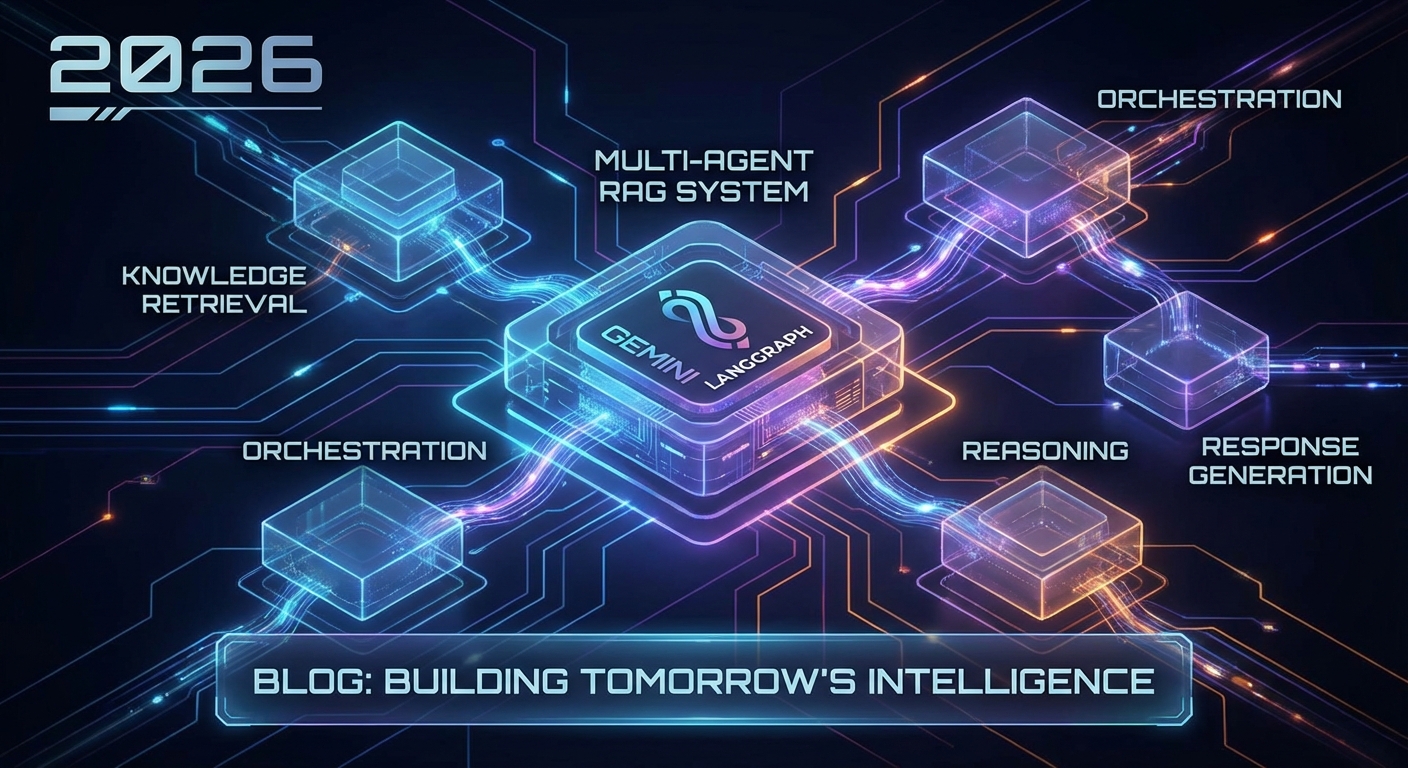
Introduction
Welcome to 2026, where the landscape of artificial intelligence has transformed from a collection of standalone models into a vibrant ecosystem of collaborative agents. The once-novel concept of Retrieval-Augmented Generation (RAG) has evolved, giving way to a more powerful and nuanced paradigm: Multi-Agent RAG. This is not just an incremental update; it's a fundamental shift in how we build and interact with AI-powered information systems.
In this post, we'll explore the cutting edge of AI-driven information retrieval. We'll delve into the architecture of Multi-Agent RAG systems, the pivotal role of Google's advanced Gemini models, and how LangGraph has become the essential tool for orchestrating these complex, intelligent workflows.
The Dawn of a New Era: From Monolithic RAG to Collaborative Intelligence
The Limitations of Traditional RAG
Traditional RAG, with its single-agent approach, was a significant step forward in reducing hallucinations and grounding AI responses in factual data. However, as our queries have become more complex and multi-faceted, the limitations of this monolithic approach have become increasingly apparent. A single agent, no matter how powerful, struggles with context-switching between different knowledge domains and understanding the subtle nuances of a complex query.
The Multi-Agent Paradigm: A "Divide and Conquer" Approach
Multi-Agent RAG systems address these challenges by adopting a "divide and conquer" strategy. Instead of a single AI trying to be a jack-of-all-trades, we now have a team of specialized agents, each with a distinct role.
A typical Multi-Agent RAG system in 2026 might look something like this:
- Query Analysis Agent: This agent acts as the team's coordinator. It deconstructs the user's query into sub-questions and determines the expertise required to answer each part.
- Specialized Search Agents: These are the domain experts. Imagine a "financial analyst" agent that can access and interpret real-time market data, or a "medical researcher" agent that is always up-to-date with the latest scientific publications.
- Validation Agent: To ensure accuracy and reliability, this agent cross-references information from multiple sources, effectively acting as a fact-checker.
- Synthesis Agent: This agent is the master communicator. It takes the validated information from the other agents and weaves it into a coherent, human-readable response.
This collaborative approach leads to more accurate, comprehensive, and contextually-aware answers, capable of tackling the most complex of queries.
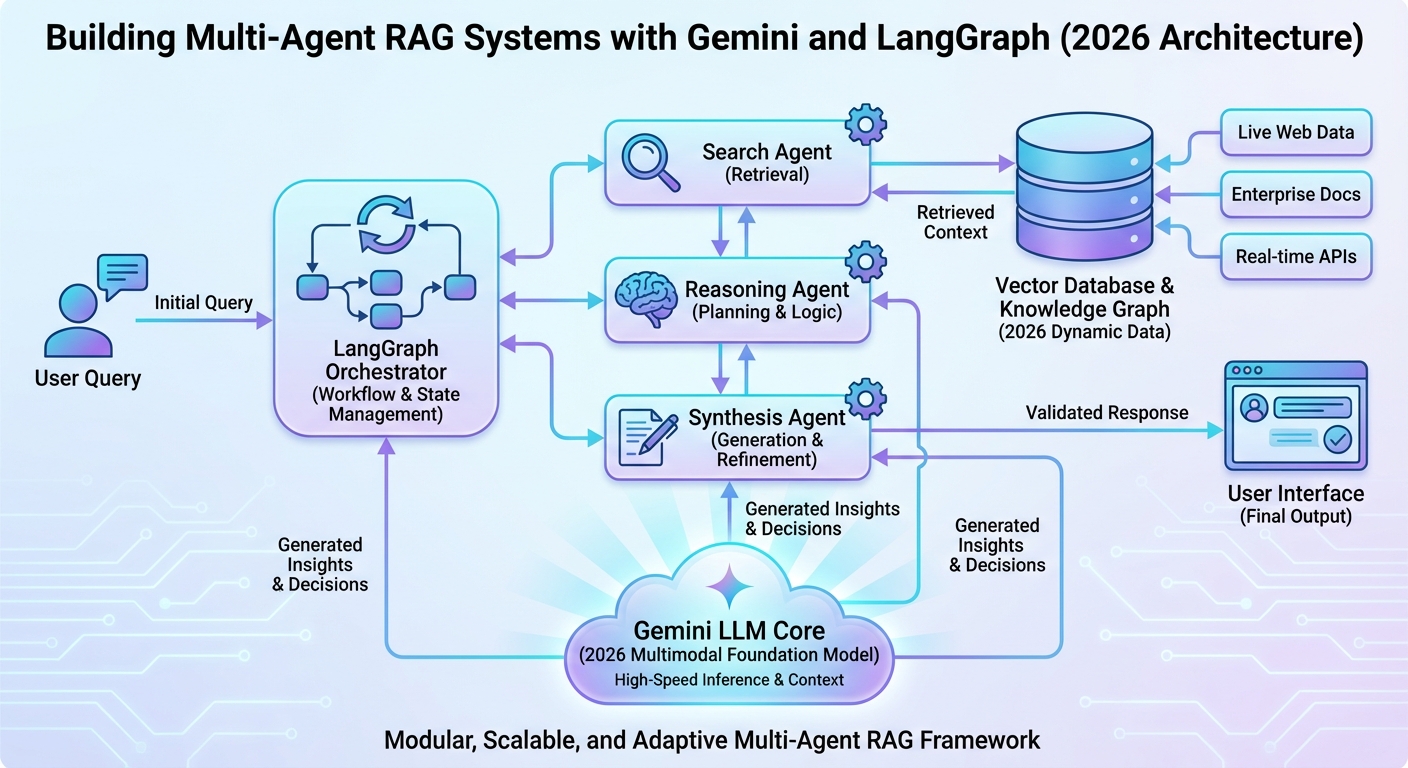 Multi-Agent RAG system workflow with specialized agents
The Powerhouse Behind the Agents: Google's Gemini in 2026
The intelligence of these agents is powered by the latest generation of Google's Gemini models. By 2026, the Gemini family has expanded, offering a range of models with capabilities that are tailor-made for the demands of multi-agent systems.
Multimodality: Beyond Text
Gemini's native multimodality is a game-changer. Agents can now seamlessly process and reason across text, images, and code. A single query might involve analyzing a financial chart, reading a PDF report, and generating a Python script for further analysis.
Expanded Context and Enhanced Function Calling
The 2026 Gemini models boast a significantly expanded context window, allowing agents to maintain a deep understanding of the conversation and the retrieved documents. Furthermore, their enhanced function calling capabilities are the backbone of agent interaction, allowing them to call upon each other's specialized skills in a dynamic and responsive way.
The Rise of Self-Correcting and Reasoning Agents
Perhaps the most significant advancement is in the reasoning capabilities of Gemini. Agents can now self-correct, identify gaps in their knowledge, and dynamically seek out additional information. This leads to a more robust and reliable system that is less prone to errors and hallucinations.
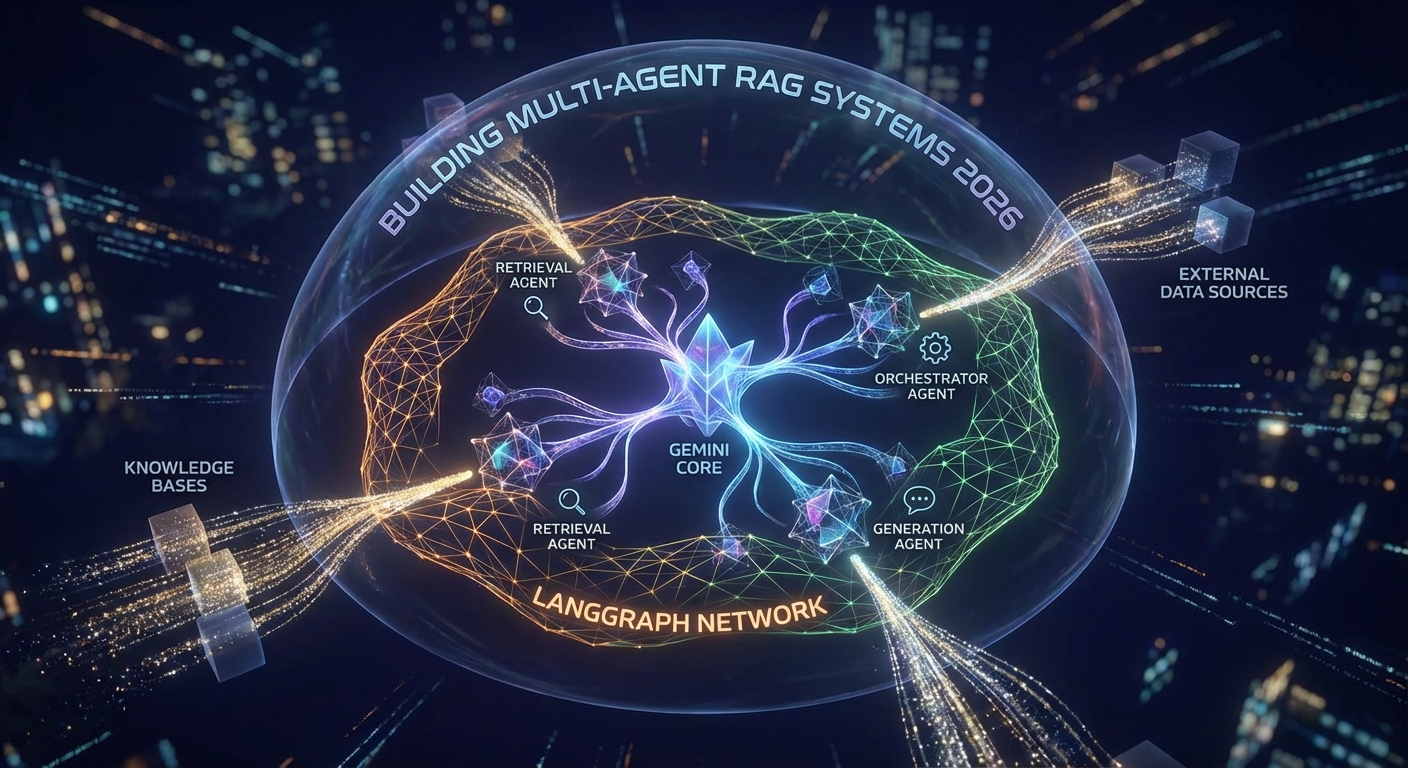 The power of Google's Gemini models driving multi-agent intelligence
The Conductor of the Orchestra: Orchestrating Agents with LangGraph
With a team of powerful agents, the next challenge is orchestration. This is where LangGraph comes in. By 2026, LangGraph has become the de facto standard for modeling the complex, cyclical, and collaborative nature of multi-agent workflows.
Why a Graph-Based Approach?
A graph is a natural way to represent a multi-agent system. Each node in the graph can represent an agent or a tool, and the edges represent the flow of information between them. This allows for complex, dynamic, and non-linear workflows that are not possible with traditional, linear approaches.
Core Features of LangGraph in 2026
- Robust State Management: LangGraph provides a powerful framework for managing the shared state of the system, allowing agents to build upon each other's work.
- Conditional Edges: This feature allows for dynamic routing of information. For example, if the Validation Agent flags a piece of information as unreliable, the system can automatically trigger a new search.
- Human-in-the-Loop: For sensitive applications, human oversight is still crucial. LangGraph's architecture makes it easy to incorporate human feedback and approval into the workflow.
- Advanced Visualization and Debugging: With the increasing complexity of these systems, the ability to visualize and debug the flow of information is essential. LangGraph's advanced visualization tools provide developers with the insights they need to optimize their multi-agent systems.

Conceptual Code Snippet: A Multi-Agent RAG Graph
Here's a simplified, conceptual Python code snippet of what a Multi-Agent RAG system might look like with LangGraph:
from langgraph.graph import StateGraph, END
from typing import TypedDict, List

# Define the state of the graph
class AgentState(TypedDict):
    query: str
    sub_questions: List[str]
    retrieved_docs: List[str]
    validated_info: str
    final_response: str

# Define the nodes (agents)
def query_analyzer(state):
    # ... logic to deconstruct the query
    return {"sub_questions": ...}

def specialized_search(state):
    # ... logic for specialized search agents
    return {"retrieved_docs": ...}

def validation_agent(state):
    # ... logic to validate information
    return {"validated_info": ...}

def synthesis_agent(state):
    # ... logic to synthesize the final response
    return {"final_response": ...}

# Define the graph
workflow = StateGraph(AgentState)
workflow.add_node("analyzer", query_analyzer)
workflow.add_node("search", specialized_search)
workflow.add_node("validator", validation_agent)
workflow.add_node("synthesizer", synthesis_agent)

# Define the edges
workflow.set_entry_point("analyzer")
workflow.add_edge("analyzer", "search")
workflow.add_edge("search", "validator")
workflow.add_edge("validator", "synthesizer")
workflow.add_edge("synthesizer", END)

# Compile the graph
app = workflow.compile()

# Run the graph
inputs = {"query": "What are the latest trends in AI-powered drug discovery?"}
for output in app.stream(inputs):
    for key, value in output.items():
        print(f"Output from node '{key}': {value}")
What's New in 2026: Trends and Advancements
The world of Multi-Agent RAG is not standing still. Here are some of the most exciting trends we're seeing in 2026:
- Proactive Agents: Agents are no longer just reactive. They can anticipate user needs, pre-fetch information, and suggest relevant follow-up questions.
- Personalization: Multi-Agent RAG systems can now be personalized to individual users, learning their preferences and adapting their responses accordingly.
- Seamless Cross-Platform Integration: These systems are no longer confined to a single application. They can now be integrated across a variety of platforms, from chatbots to enterprise search engines.
The Road Ahead: Challenges and Opportunities
Despite the incredible progress, there are still challenges to overcome:
- Orchestration Complexity: As the number of agents and the complexity of their interactions grow, so does the challenge of orchestrating them effectively.
- Cost and Latency: Running multiple powerful AI models in parallel can be expensive and can introduce latency.
- Data Privacy: As these systems become more personalized, ensuring the privacy and security of user data is more important than ever.
Key Takeaways
- The Future is Collaborative: Multi-Agent RAG is the new frontier of AI-powered information retrieval.
- Specialization is Key: A "divide and conquer" approach with specialized agents leads to more accurate and comprehensive answers.
- Gemini is the Engine: The advanced capabilities of Google's Gemini models are the driving force behind these intelligent agents.
- LangGraph is the Conductor: LangGraph provides the essential tools for orchestrating these complex, multi-agent workflows.
Conclusion
The combination of Multi-Agent RAG, Gemini models, and LangGraph represents a significant leap forward in our ability to access and interact with information. As we look to the future, we can expect to see these systems become even more intelligent, personalized, and seamlessly integrated into our daily lives. The era of collaborative AI is here, and it's set to redefine our relationship with technology.
Author: Vidvatta Team Category: AI Architecture & Engineering Difficulty Level: Advanced Estimated Reading Time: 12-15 minutes
Ready to build your own multi-agent system? Start exploring LangGraph and Google Gemini today!
Related Topics
Related Resources
Semantic Search and Retrieval-Augmented Generation (RAG)
Unlock the power of Semantic Search and Retrieval-Augmented Generation (RAG) using Generative AI. Learn how modern AI systems extract information, improve accuracy, and deliver truly contextual responses.
articleAI Safety Failures in LLM, RAG, and Agent Systems: Long-Horizon Risks, Root Causes, and Practical Mitigations
Research-grade guide to AI safety failures in LLM, RAG, and agents: causes, evaluations, long-horizon risks, mitigations, and practice.
articleRAG Systems
The blog helps you in implementing and using RAG which is most popular LLM application