
Guardrails with LangChain Middleware for Financial Document Extraction RAG Systems
Why Guardrails Matter in Financial Document Extraction RAG
Financial document extraction in a Retrieval-Augmented Generation (RAG) pipeline is not merely an information access problem; it is a controlled transformation problem under strict correctness, auditability, and policy constraints. We assume a setting with semi-structured filings (for example, 10-Ks, annual reports, covenant packages, and earnings supplements), mixed OCR quality, and high-stakes downstream use such as risk scoring, compliance review, covenant monitoring, or portfolio analytics. Under these assumptions, unconstrained LLM behavior is unacceptable: extraction must be surrounded by deterministic guardrails.
A core failure mode is hallucinated fields. Financial documents often contain visually proximate but semantically distinct values—e.g., “net income attributable to common shareholders” versus “comprehensive income.” An LLM may infer a requested field even when the exact item is absent, especially under pressure to return complete JSON. In regulated workflows, a plausible-but-fabricated value is often worse than a null.
Another class of errors is numeric corruption, which includes:
- OCR-induced digit substitution (
8vs3,0vsO) - Unit confusion (
thousands,millions, basis points) - Sign inversion from parenthetical accounting notation
- Period misalignment across quarterly and trailing-twelve-month disclosures
These errors are especially dangerous because they are syntactically valid and may pass superficial schema checks.
Provenance loss is equally critical. If extracted values are not bound to source spans, page numbers, table regions, or document versions, investigators cannot reproduce outcomes. RAG systems without citation-preserving middleware often degrade traceability as information moves from retrieval to summarization to structured output.
Under agentic orchestration, additional risks emerge:
- Stale retrieval from outdated filings or superseded amendments
- Tool-selection errors across retrieval, OCR, parsing, and validation stages
- Policy violations, such as exposing restricted sections, mixing issuer entities, or bypassing human-review thresholds
Guardrails matter because they convert the system from a best-effort assistant into a bounded extraction mechanism. In financial settings, the objective is not maximal fluency; it is controlled failure: abstain when uncertain, preserve provenance, validate numerics, and enforce policy at every middleware boundary.
Reference Architecture: LangChain Middleware as the Guardrail Control Plane
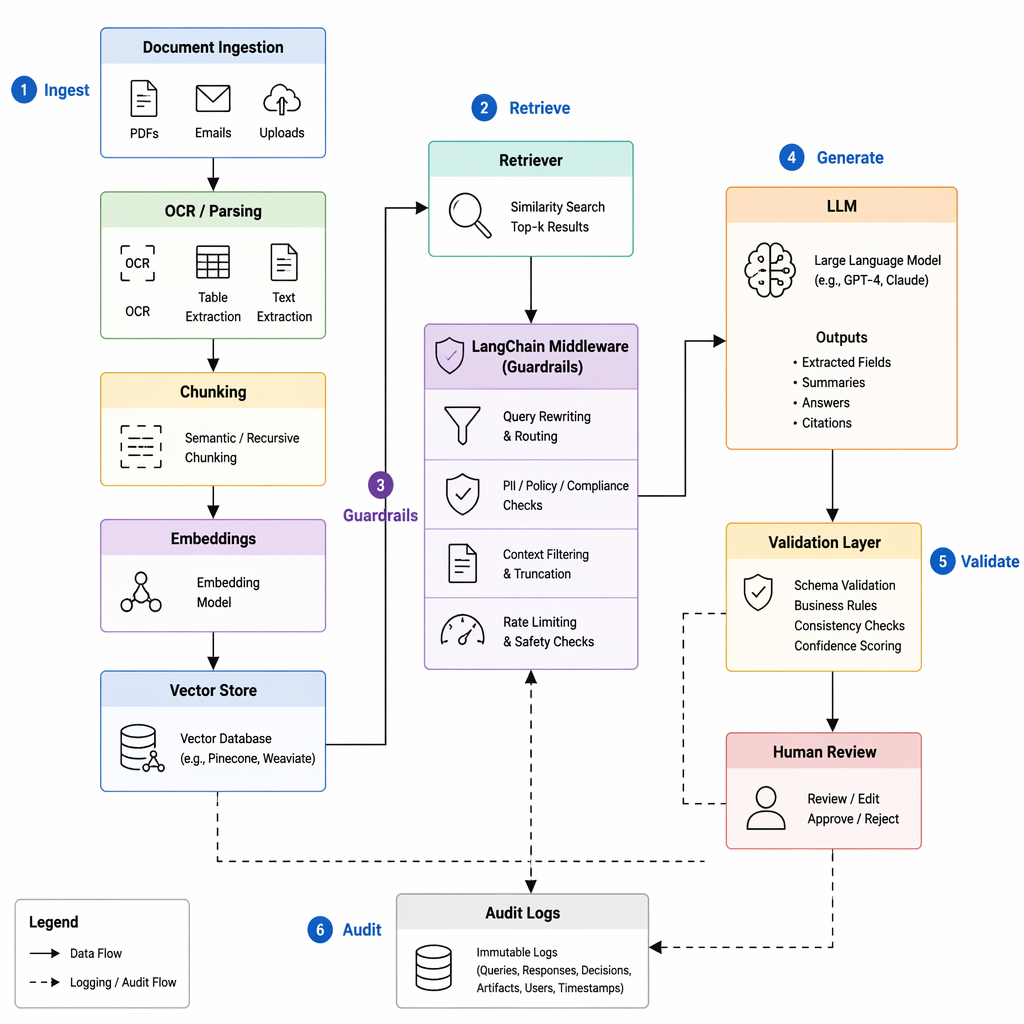
A production-grade financial document extraction RAG stack benefits from treating LangChain middleware as the guardrail control plane rather than as an incidental utility layer. In this architecture, middleware sits on the critical path at three enforcement points:
- Pre-retrieval
- Pre-model invocation
- Post-generation
At the pre-retrieval stage, middleware evaluates the inbound request for authentication context, tenant isolation, document entitlements, PII handling rules, jurisdictional constraints, and query risk signals. This is the right place to normalize user intent, reject policy-violating requests, redact sensitive fields, and constrain retrieval scope to approved collections. In financial settings, this prevents the retriever from ever seeing unauthorized search space, which is materially stronger than trying to filter unsafe content later.
Before model invocation, middleware can enforce prompt hardening, schema binding, tool allowlists, token budgets, deterministic parameter policies, and trace metadata propagation. This layer also supports dynamic controls such as: selecting a stricter model for regulated workflows, disabling free-form reasoning exposure, or requiring citation-grounded extraction when confidence is low. Conceptually, middleware mediates between orchestration and inference, giving operators a centralized policy surface independent of any single model vendor.
After generation, middleware performs schema validation, citation verification, output classification, hallucination heuristics, confidence gating, compliance checks, and redaction/rewrite actions before results are returned or persisted. A common pattern is “generate → validate → repair or reject,” especially for extracting values such as covenants, rates, maturity dates, or counterparty names.
Compared with alternatives:
- Prompt-only guardrails are easy to deploy but weak against prompt injection, model drift, and non-deterministic adherence.
- Standalone validators are useful for deep checks, but without middleware they are often bolted on after risk has already propagated.
- Model-native tool constraints can tightly restrict action spaces, but they are provider-specific and rarely sufficient for end-to-end compliance governance.
The practical conclusion is that middleware provides the best cross-cutting enforcement layer, while prompts, validators, and model-native constraints remain complementary controls within a defense-in-depth architecture.
Practical Guardrail Patterns for Financial Extraction Pipelines
In production financial extraction pipelines, guardrails are most effective when applied at multiple middleware boundaries rather than treated as a single post hoc validation step. For RAG systems over term sheets, offering memoranda, indentures, and prospectuses, a robust pattern is route → retrieve → constrain → validate → retry/escalate.
A first layer is document-type routing. Before retrieval, classify the artifact into coarse classes such as bond prospectus, loan agreement, or structured note supplement, then dispatch to a specialized retriever and extraction schema. This reduces prompt ambiguity and narrows field expectations.
from pydantic import BaseModel
from langchain_core.runnables import RunnableLambda

class DocRoute(BaseModel):
    doc_type: str
    issuer: str | None = None
    as_of_date: str | None = None

router = RunnableLambda(lambda x: DocRoute(**x))
A second layer is metadata-aware retrieval filtering. In finance, issuer and effective date materially change the truth set, so vector retrieval should be constrained by metadata predicates, not semantic similarity alone. For example, retrieve only chunks where issuer == "Acme Corp" and document_date <= pricing_date. This is especially important for amended filings and shelf supplements.
Next, enforce a strict extraction schema with typed fields and domain validators. Coupon rate, maturity date, call date, currency, and denomination should not be free text.
from pydantic import BaseModel, Field, field_validator
from datetime import date

class BondTerms(BaseModel):
    coupon_rate: float = Field(ge=0, le=100)
    maturity_date: date
    currency: str
    citation_span: str
    confidence: float = Field(ge=0, le=1)

    @field_validator("currency")
    @classmethod
    def iso_currency(cls, v):
        assert v in {"USD", "EUR", "GBP"}
        return v
Two additional guardrails should be mandatory:
- Confidence thresholds: reject or retry extractions below a calibrated confidence score.
- Citation and numeric consistency checks: require each extracted field to map to a source span, then verify that parsed values match the cited text exactly or within a defined normalization rule.
A practical post-processor can implement this:
import re

def validate_numeric_consistency(result: BondTerms):
    m = re.search(r'(\d+(\.\d+)?)\s*%', result.citation_span)
    if m and abs(float(m.group(1)) - result.coupon_rate) > 1e-6:
        raise ValueError("Coupon rate inconsistent with citation span")
    return result
Finally, use retry policies strategically: first retry with tighter retrieval filters, then with a narrower prompt, and only then escalate to human review. This is preferable to unconstrained retries, which often amplify hallucinated structure rather than improve factual accuracy.
End-to-End Workflow: From Raw Financial PDF to Auditable Structured Output
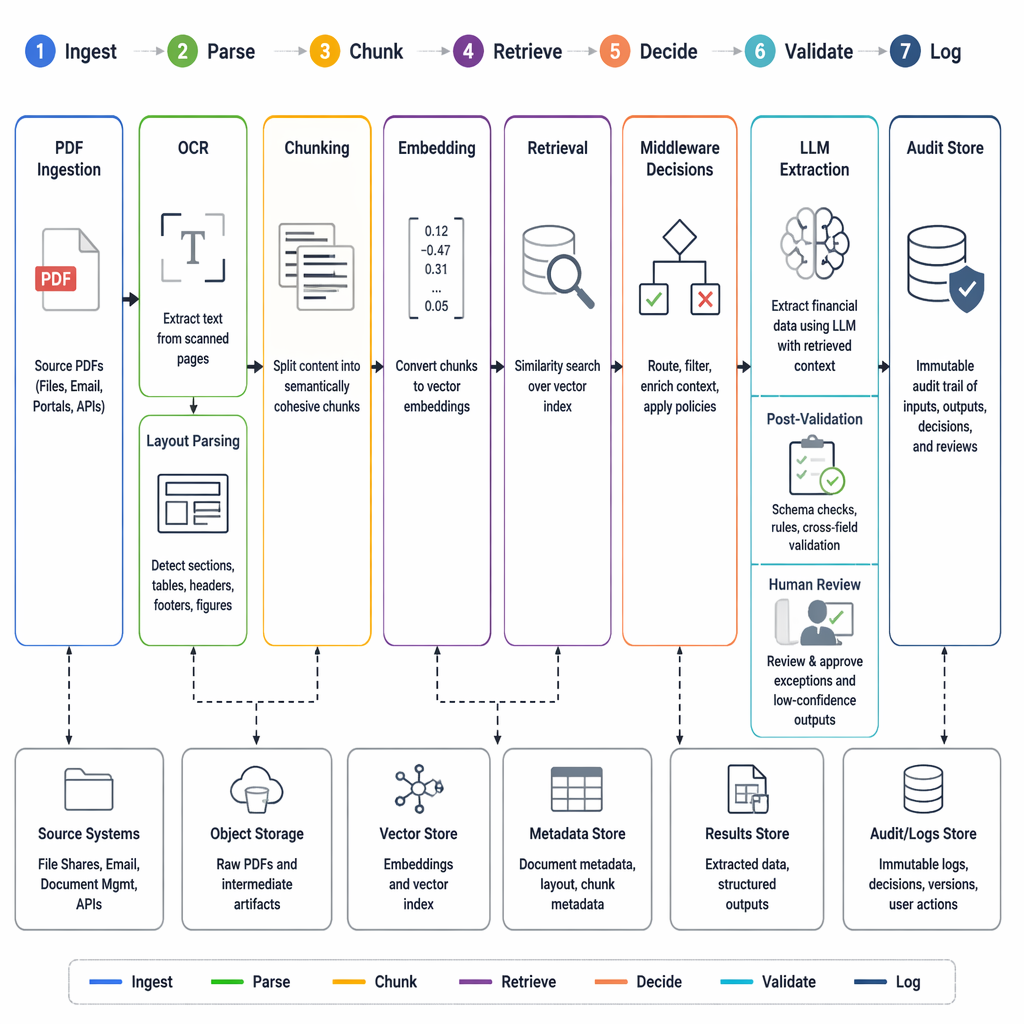
A robust financial-document extraction pipeline should be designed as a controlled transformation chain, not merely a sequence of model calls. In practice, the workflow begins with ingestion of annual reports, bond prospectuses, or loan agreements in PDF form, followed by OCR normalization, layout recovery, page-level hashing, and metadata assignment. At this stage, middleware should enforce document admissibility checks: corrupted files, low OCR confidence, missing page ranges, or unapproved document classes should be blocked before they enter retrieval or extraction.
After ingestion, the document is segmented into traceable chunks. For financial text, naive fixed-token chunking is often inferior to structure-aware chunking that preserves tables, section headers, footnotes, and covenant definitions. Each chunk should carry immutable provenance fields such as:
document_idpage_numberchunk_idsection_titlecontent_hashocr_confidence
These identifiers must propagate through embeddings, retrieval, model prompts, and final outputs. Without this, auditability collapses.
During retrieval, middleware should constrain tool selection boundaries. For example, the agent may be allowed to query only approved vector stores and document metadata indexes, but not external web search or unrestricted code execution. This reduces leakage risk and prevents “creative” but non-compliant retrieval behavior. Retrieved passages should then flow into an extraction stage that targets a schema: coupon rate, maturity date, EBITDA definition, leverage covenant threshold, and so on.
Here, middleware becomes critical. It should:
- Block malformed JSON, unsupported schema fields, or missing citations
- Repair minor format issues, unit normalization, and date standardization
- Escalate low-confidence or cross-chunk contradictions to a human reviewer
A simplified control pattern is:
if not output.has_citations():
    raise GuardrailBlock("Missing source attribution")
if output.confidence < 0.85 or output.has_conflict():
    return escalate_to_human(output)
return normalize_and_store(output)
Agent-system concerns are especially important under retries. Unbounded retries can create retry storms, amplifying cost and inconsistency. Middleware should enforce retry budgets, idempotency keys, and state propagation rules so each attempt preserves prior validation results and failure reasons. Finally, every decision—retrieved chunks, prompt version, model version, validation outcome, repair action, and escalation event—should be written to an audit log. The result is not just structured extraction, but an auditable, reproducible record of how each financial field was derived.
Common Mistakes, Failure Analysis, and Testing Strategies
A recurring anti-pattern in financial-document RAG pipelines is treating prompts as the primary control surface. Prompt instructions can improve formatting compliance, but they are not a substitute for deterministic middleware that enforces schema, provenance, unit constraints, and escalation logic. In practice, prompt-only systems fail under distribution shift: OCR noise, unfamiliar table layouts, multi-currency disclosures, or footnotes that invert the apparent meaning of a headline number. For extraction tasks, guardrails should therefore be implemented post-retrieval and post-generation, not merely requested in natural language.
Another common failure mode is unit and scale inconsistency. Financial statements routinely mix USD vs. EUR, thousands vs. millions, and period-end vs. trailing-twelve-month values. Systems that validate only type correctness—e.g., “this is a number”—will silently pass semantically wrong outputs. The same applies to OCR confidence: low-confidence spans should not be treated as equivalent to machine-readable text. A robust middleware layer should down-weight or quarantine weak OCR regions, require corroboration from multiple evidence spans, and trigger fallback behavior such as abstention, human review, or alternate parsers.
Citation weakness is equally damaging. Requiring a citation string is insufficient if the cited chunk does not actually support the extracted value. Similarly, many teams validate syntax but not semantics: JSON parses successfully, but the extracted “net income” may actually correspond to operating income, or a prior-year comparator rather than the target period.
A research-grade evaluation strategy should combine:
- Field-level precision, recall, and F1, not just document-level success.
- Calibration analysis: compare confidence scores to empirical correctness via reliability diagrams and expected calibration error.
- Retrieval attribution metrics: measure whether the cited evidence truly contains and supports the extracted field.
- Adversarial test sets with unit swaps, negation in footnotes, ambiguous table headers, and OCR corruption.
- Scenario-based red teaming targeting failure classes such as cross-page tables, amended filings, and contradictory disclosures.
A minimal test harness might look like:
def score_field(pred, gold):
    exact = pred.value == gold.value
    unit_ok = pred.unit == gold.unit
    citation_ok = gold.source_span in pred.citations
    semantic_ok = pred.label == gold.label and pred.period == gold.period
    return {
        "exact": exact,
        "unit_ok": unit_ok,
        "citation_ok": citation_ok,
        "semantic_ok": semantic_ok
    }
The key principle is simple: test the full claim pipeline—retrieval, parsing, normalization, attribution, and abstention—not just whether the model emitted valid JSON.
Limitations, Alternative Designs, and When to Add Human Oversight
Middleware guardrails are valuable because they sit at a high-leverage control point in a RAG pipeline, but they are not equivalent to correctness guarantees. In financial document extraction, their primary limitation is distributional brittleness: policies that work on SEC filings, earnings call transcripts, or standard audited statements often degrade when confronted with novel layouts, embedded tables, scanned footnotes, multilingual disclosures, or issuer-specific terminology. A middleware validator can reject malformed outputs, enforce schemas, and block disallowed claims, yet still fail when the underlying retrieval or parsing stack misinterprets the source.
A second limitation is the precision–recall tradeoff. Strict filters reduce hallucinations, but they can also generate costly false positives by rejecting valid but unusual facts—for example, a nonstandard segment label or a covenant ratio reported in narrative rather than tabular form. More fundamentally, middleware usually verifies surface properties: field presence, source citation, confidence thresholds, regex patterns, or cross-field consistency. It does not reliably detect latent reasoning errors, such as unit mismatches, temporal misalignment, incorrect attribution across subsidiaries, or silently propagated OCR defects. In practice, proving semantic correctness for extracted financial facts remains difficult because “correctness” often depends on accounting context, filing scope, and interpretation of footnotes rather than literal text matching.
Alternative designs each shift the failure boundary:
- Constrained decoding improves structural validity at generation time, but not factual grounding.
- Rule engines provide deterministic checks and auditability, but are expensive to maintain under document drift.
- Graph-based provenance systems strengthen traceability by linking facts to spans, tables, and transformations, though they add implementation complexity.
- Specialized IE models for tables, entities, and relations often outperform general LLMs on narrow tasks, but can be less adaptable to new schemas.
Human oversight becomes mandatory when outputs drive material decisions: investment recommendations, regulatory reporting, covenant monitoring, valuation inputs, or exception handling involving ambiguous disclosures. A practical standard is simple: if an extraction error could produce financial loss, compliance exposure, or misleading analysis, require reviewer sign-off, with provenance and source evidence surfaced directly in the workflow.
Related Topics
Related Resources
The Agentic Shift: How Autonomous AI Will Redefine Banking, Finance, and Insurance by 2026
By 2026, the financial services industry will cross a critical threshold, moving beyond the era of AI that merely suggests to one where AI autonomously acts. This comprehensive analysis explores the impending transition from Generative to Agentic AI in the BFSI sector. We will dissect the multi trillion dollar economic impact, explore production grade use cases, and confront the profound strategic, compliance, and systemic risks that autonomous agents introduce, providing a C suite playbook for navigating this new reality.
articleFrontier Models, Broken Boundaries, and Why Sandboxing Is Core AI Infrastructure
Learn what frontier models are, how AI crossed cyber boundaries, and how sandboxing, RAG controls, and containment reduce real deployment risk.
articleAI Safety Failures in LLM, RAG, and Agent Systems: Long-Horizon Risks, Root Causes, and Practical Mitigations
Research-grade guide to AI safety failures in LLM, RAG, and agents: causes, evaluations, long-horizon risks, mitigations, and practice.